Most job seekers approach their search the same way: open a job board, find a posting, send a resume, and wait. When nothing happens, they repeat the process — often for months. The problem is not the effort. It is the strategy.
A structured job search strategy changes the outcome. It replaces reactive application-sending with proactive targeting, relationship-building, and deliberate preparation. The six strategies below are drawn from more than 20 years of career coaching and vocational rehabilitation practice across Canada.
Featured resource
The Complete Job Search Journey
A successful job search involves much more than submitting applications. The infographic below highlights seven key interview strategies that help candidates build confidence, avoid common mistakes, and improve their chances of success at every stage of the hiring process.
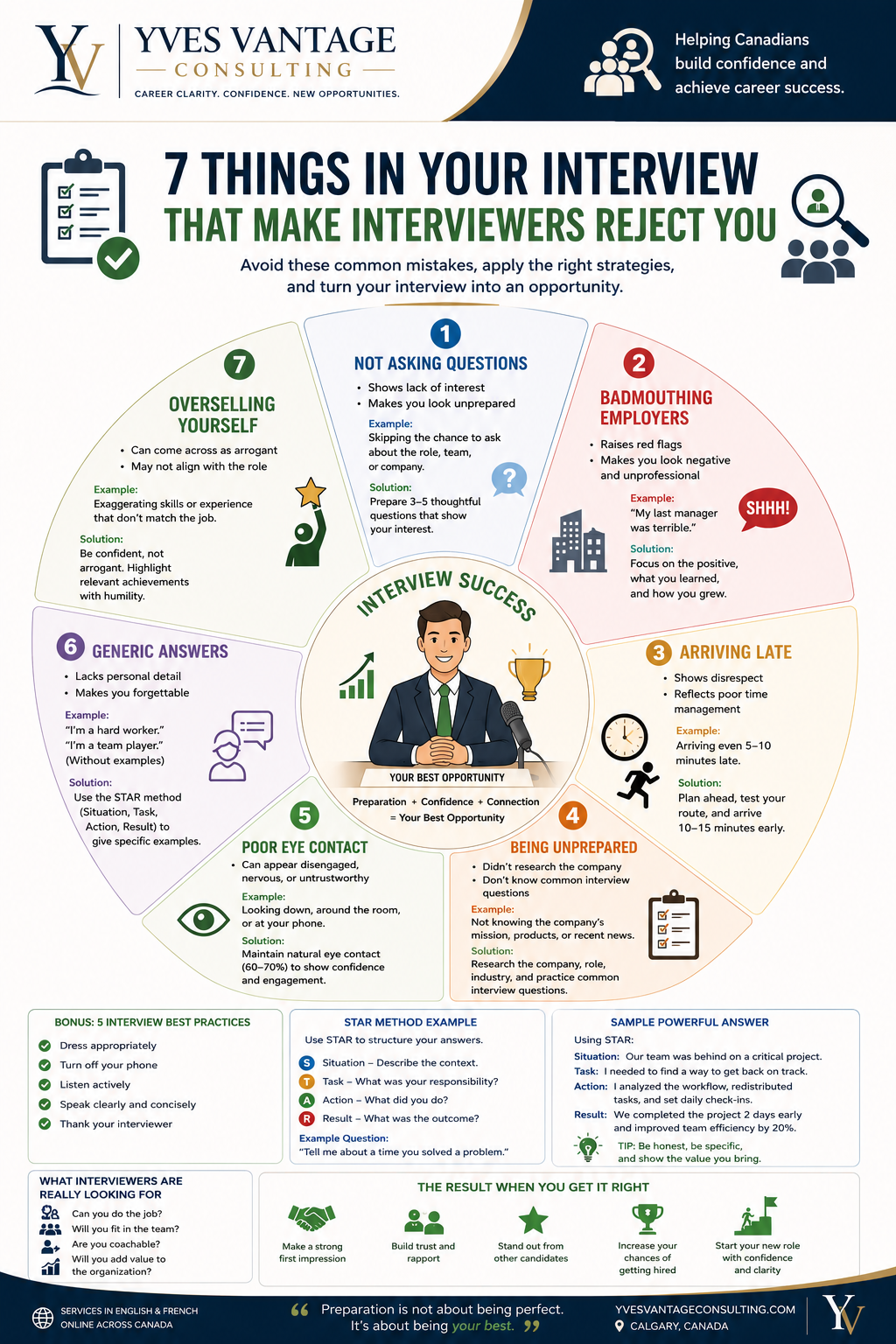
Infographic: 7 Interview Mistakes That Make Interviewers Reject You — and how to avoid each one. Produced by Yves Vantage Consulting.
The framework
Six strategies that produce results
These strategies apply whether you are entering the workforce for the first time, returning after a career break, changing industries, or navigating a layoff. They are the foundation of every effective job search.
Define your target
Before you send a single application, clarify exactly what you are looking for: industry, role type, company size, culture, and geography. Unfocused job seekers spend months applying broadly and hearing nothing. Focused job seekers spend weeks applying selectively and landing interviews.
Tailor every application
Generic resumes and cover letters are the single biggest reason qualified candidates are screened out. Hiring managers read dozens of applications per role. A resume that mirrors the language of the job posting — and demonstrates specific, quantified achievements — stands out immediately.
Activate your network
Research consistently shows that 70–80% of Canadian jobs are never publicly posted. They are filled through referrals, internal promotions, and direct outreach. LinkedIn connections, alumni networks, industry associations, and informational interviews are your fastest path to the hidden job market.
Research employers proactively
Identify 20–30 target employers and research them thoroughly before you apply or reach out. Understand their recent news, strategic priorities, culture, and hiring patterns. This knowledge transforms your cover letter, your networking conversations, and your interview performance.
Prepare for every interview
Interview preparation is not optional — it is the difference between a callback and a rejection. Research the company, prepare STAR-method answers for common behavioural questions, and practise out loud. Candidates who prepare consistently outperform those who rely on improvisation.
Follow up consistently
A brief, professional follow-up email within 24 hours of an interview demonstrates initiative and keeps you top of mind. Most candidates do not follow up. Those who do are remembered — and often preferred — when hiring decisions are made.
Key insight
70–80% of Canadian jobs are never posted publicly.
The hidden job market — positions filled through referrals, internal promotions, and direct outreach — is where most hiring happens. Building a strong LinkedIn presence, maintaining professional relationships, and reaching out proactively gives you access to opportunities that most applicants never see.
Explore job search support servicesCommon questions
Frequently asked questions
How long does a typical job search take in Canada?
The average Canadian job search takes between 3 and 6 months, depending on the industry, seniority level, and how targeted your strategy is. Professionals who use a focused, structured approach — targeting specific employers, tailoring their materials, and networking actively — typically find roles faster than those who rely on mass applications alone.
What is the most effective job search strategy in Canada?
The most effective strategy combines a targeted employer list, a tailored resume and LinkedIn profile, proactive networking (including informational interviews), and consistent follow-up. Research consistently shows that 60–80% of positions are filled through networking rather than posted job boards.
Should I apply to every job posting I find?
No. A targeted approach — applying to 5–10 well-matched roles per week with tailored materials — consistently outperforms mass applications. Quality of applications matters far more than volume. Hiring managers can tell when a resume has not been customized for their role.
How important is networking in a Canadian job search?
Networking is critical. Studies estimate that 70–80% of jobs in Canada are never publicly posted. Building relationships through LinkedIn, industry associations, alumni networks, and informational interviews gives you access to the hidden job market that most applicants never reach.
What is the hidden job market?
The hidden job market refers to positions that are filled through referrals, internal promotions, or direct outreach before they are ever advertised publicly. Accessing this market requires proactive networking, a strong LinkedIn presence, and the confidence to reach out to hiring managers and industry contacts directly.
Ready to move forward?
Get expert job search support
Working with a Certified Vocational Rehabilitation Professional gives you a structured plan, targeted materials, and the confidence to pursue the right opportunities — not just the available ones.
Career Coaching
Clarify your direction, build a targeted search plan, and stay accountable.
Learn moreResume Writing
A professionally written, ATS-optimized resume tailored to your target roles.
Learn moreInterview Coaching
Practise STAR-method answers, sharpen your delivery, and walk in prepared.
Learn moreAbout the author
Yves Gagnon, BREC, RRP, CVRP-TSA, CCDP, RTWDM
Yves Gagnon is a Certified Vocational Rehabilitation Professional with more than 20 years of experience helping Canadians navigate career transitions, return-to-work planning, resume development, and job search strategy. He provides career coaching and consulting services online across Canada via Zoom and Microsoft Teams. Learn more about Yves.
Keep reading
Continue building your job search strategy
7 Interview Mistakes That Can Cost You the Job
Avoid the seven most common interview errors — with practical solutions and a STAR method example — so you walk in prepared and walk out confident.
Read articleThe Ultimate Resume Checklist: 25 Things to Review Before You Click Apply
A complete 25-point checklist covering formatting, contact information, professional summary, work experience, and ATS optimization.
Read articleWill a Professional Resume Get Me More Interviews?
An evidence-based look at whether investing in a professionally written resume translates into more callbacks and better job offers.
Read articleHow to Prepare for a Career Transition
A structured approach to navigating a career change — from self-assessment and skills mapping through to your first 90 days in a new role.
Read article